
Keeping the rectum, not removing it
For decades, curing early rectal cancer has meant a trade most patients never really got to weigh: remove the whole rectum, and with it often normal bowel, bladder, and sexual function, plus a permanent stoma bag. The STAR-TREC trial set out to test whether many of those people could keep their rectum instead, and its 12-month results say a surprising number can.
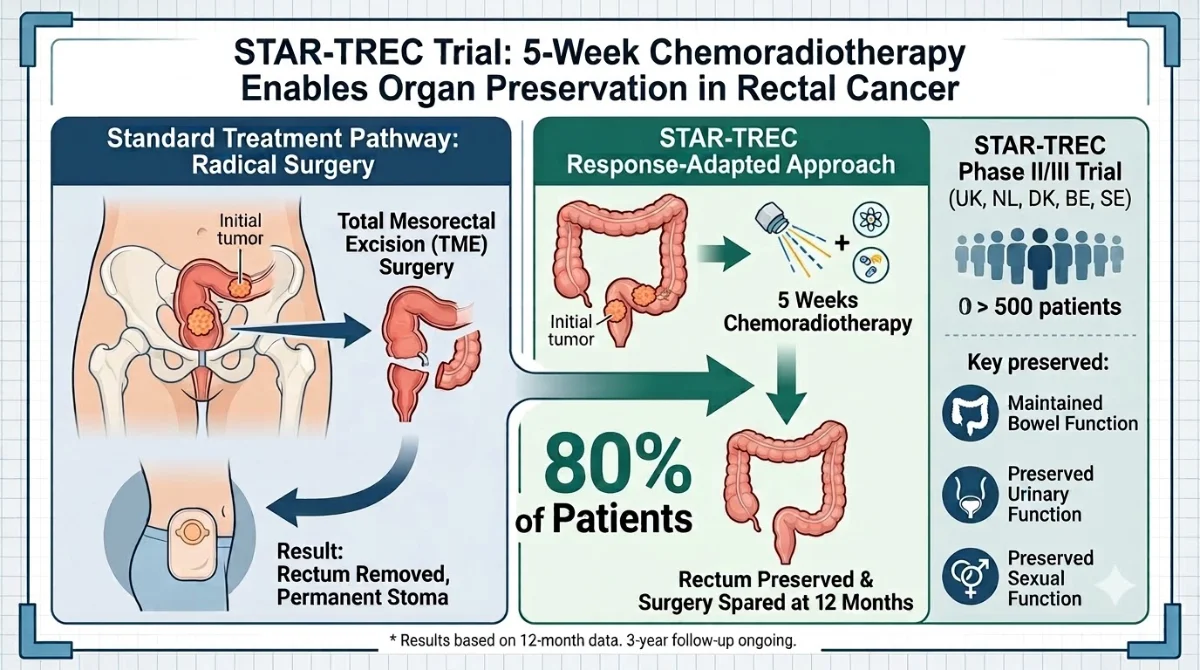
In the trial, four in five patients (80%) given a five-week course of chemoradiotherapy avoided radical surgery at one year and kept their rectum intact. A shorter five-day radiotherapy course worked too, just for fewer people. The study ran across more than 500 patients in five countries, which makes the signal hard to wave away.
One caution up front, and the researchers say it plainly: these are one-year numbers. Whether the cancer stays away over the long run is the question that three more years of follow-up are meant to answer.
What the STAR-TREC numbers actually mean
| Finding | Plain-English meaning |
|---|---|
| 80% spared surgery (5-week chemoradiotherapy) | Four in five people on the longer drug-plus-radiation course kept their rectum and skipped radical surgery at 12 months. |
| 61% spared surgery (short-course radiotherapy) | The 5-day radiation-only course also worked, but for fewer people, so the extra chemotherapy weeks added a real edge. |
| 78.5% vs 60.6% surgery-free survival | Measured strictly, the chemoradiotherapy group stayed surgery-free at a noticeably higher rate than the radiotherapy-only group. |
| Over 500 patients, 5 countries | A large international trial (UK, Netherlands, Denmark, Belgium, Sweden), not a small single-hospital study, so the signal is harder to dismiss. |
| ~4,100 UK diagnoses a year | Roughly how many people in the UK are told each year they have early-stage rectal cancer, the group this could help. |
| 12-month results, 3-year follow-up to come | These are one-year outcomes. Whether the cancer stays away long term is still being tracked and is the open question. |
Early-stage rectal cancer care shifting from radical removal to organ preservation
Standard surgical management for early-stage rectal cancer (a form of bowel cancer) has relied heavily on radical resection, known as total mesorectal excision. This invasive procedure involves the complete surgical removal of the patient’s rectum. While total removal eliminates localized tumors, it comes at a steep physiological cost. Patients frequently endure long-term bowel dysfunction, urinary complications, sexual dysfunction, and the permanent necessity of a colostomy bag to collect bodily waste through an opening in the abdominal wall called a stoma.
Across the UK, roughly 4,100 people receive an early-stage rectal cancer diagnosis each year. For these individuals, radical surgical treatment carries permanent lifestyle alterations. Surgical procedures also demand major resources from National Health Service (NHS) operating rooms and create ongoing clinical requirements for stoma supplies.
The 12-month outcomes from the STAR-TREC trial present a response-adapted strategy focused on organ preservation. By treating localized tumors with targeted therapies prior to surgical decisions, oncologists can shrink tumors entirely, allowing patients to retain their natural organ function.
How the response-adapted chemoradiotherapy protocol operates
Chemoradiotherapy combines targeted radiation therapy with systemic chemotherapy drugs. The radiation acts like a focused beam that disrupts cancer cell DNA, while chemotherapy drugs sensitize tumor cells to increase radiation effectiveness.
Co-coordinated by the Cancer Research UK Clinical Trials Unit at the University of Birmingham alongside University College London (UCL) and the University of Leeds, the open-label STAR-TREC trial randomly assigned over 500 patients across three primary pathways:
- Control Arm: Traditional radical surgical removal of the rectum.
- Experimental Arm 1: Five weeks of intensive chemoradiotherapy.
- Experimental Arm 2: Five days of short-course radiation therapy.
Under the trial protocol, participants in the radiation arms were evaluated following treatment. If the tumor disappeared completely, clinicians cancelled radical surgery entirely. If small localized tumor remnants persisted, surgeons performed minimal rectum-preserving surgery to remove only the residual scar tissue while leaving the surrounding organ intact.
The 12-month findings published in The Lancet Oncology (DOI: 10.1016/s1470-2045(26)00228-7) showed the 5-week chemoradiotherapy rectal cancer protocol edged out the 5-day short-course radiation regimen for organ preservation. Eighty percent of patients in the 5-week arm avoided radical surgery altogether, against about 61% in the short-course radiotherapy arm. Measured as surgery-free survival, that gap was 78.5% versus 60.6%. Both approaches spared a lot of people major surgery, but the extra chemotherapy weeks bought a meaningful advantage, and severe short-term side effects stayed low.
“For decades we’ve asked patients to accept the loss of their rectum, and often a permanent stoma, as the price of curing their cancer,” said Professor Simon Bach, co-chief investigator of the STAR-TREC trial, honorary chair at the University of Birmingham, and professor of colorectal surgery at UCL. “These results suggest that for many people, this price no longer has to be paid. Four in five patients treated with chemoradiotherapy kept their rectum. The next step is to confirm these results hold over the longer term, and then to make sure the approach is available to every patient who could benefit.”
Professor David Sebag-Montefiore, co-chief investigator and professor of clinical oncology at the University of Leeds, noted: “These exciting results are an example of how a smarter, kinder radiotherapy treatment may allow patients to avoid the need for major surgery.”
The part the headlines skip
The honest catch is time. These are 12-month numbers. Rectal cancer can return, and the whole point of removing the rectum was to lower that risk. STAR-TREC is following patients for three more years to see whether the cancers that looked gone stay gone and whether survival matches surgery. Until that reads out, “spared surgery at one year” is not the same as “cured without surgery.” The trial also leaned on careful response checks, so this is not a blanket skip-surgery result, it is an organ-preservation option for people whose tumours shrink enough on treatment.
What to do if this affects you or a family member
If you or someone close to you has just been diagnosed with early-stage or intermediate-stage rectal cancer, this is a reason to ask a specific question, not to assume surgery is off the table. Ask the treating team whether a response-adapted, organ-preserving pathway (chemoradiotherapy or short-course radiotherapy with close monitoring) is an option in your case, and what the trade-off is between keeping the rectum now and the long-term recurrence risk. For many people radical surgery will still be the right call. The value of STAR-TREC is that “keep the rectum” is now a real conversation to have, backed by a large trial, rather than a hope.
Related Coverage
Sources:
- medicalxpress.com, “Clinical trial to treat rectal cancer spares major surgery” (https://medicalxpress.com/news/2026-08-clinical-trial-rectal-cancer-major.html)
- emjreviews.com, “New Cancer Treatment Option to Save Thousands From Major Surgery” (https://www.emjreviews.com/general-healthcare/news/new-cancer-treatment-option-to-save-thousands-from-major-surgery/)
- thelancet.com, “Chemoradiotherapy versus short-course radiotherapy for response-adapted organ preservation in early-stage and intermediate-stage rectal cancer (STAR-TREC): 12-month results” (https://doi.org/10.1016/s1470-2045(26)00228-7)
Disclaimer: This article is for general information only and does not constitute medical advice, diagnosis, or treatment. Always consult a qualified healthcare provider about any medical condition or before making health decisions.