
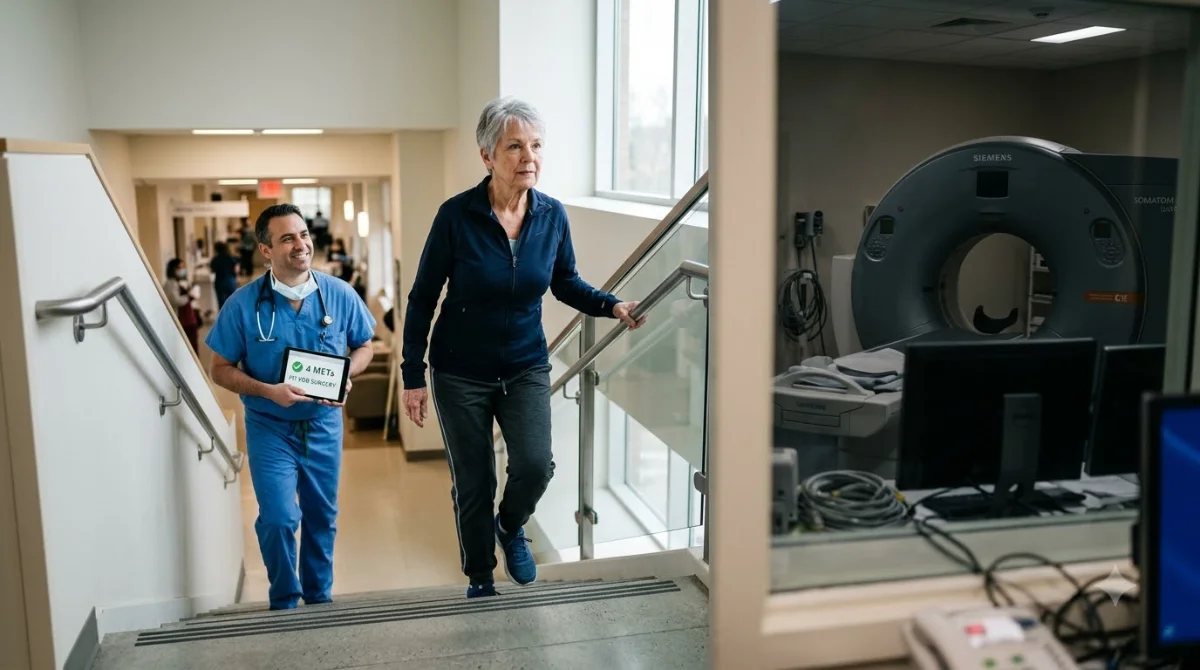
The most important number isn’t on the birth certificate
Forget the birth certificate. The most important number for an older adult facing surgery isn’t their age, it’s whether they can climb a flight of stairs. This simple act is a better predictor of heart attack risk after surgery than a battery of expensive cardiac tests. And it’s free. This is the central, underappreciated truth from a foundational 2015 review that remains critically relevant today. We are operating on more people over 70 than ever, yet standard practice often misses what actually matters: physiologic reserve, not chronology. The consequences of getting this wrong are a cascade of preventable harm, from delirium that steals memories to blood pressure management that causes kidney failure.
The numbers most pre-op advice skips
The review hangs on a few figures that rarely make it into the conversation between a family and a surgeon. Here is what they actually mean.
| Finding | Plain-English meaning |
|---|---|
| Only blood pressure above 180/110 mmHg is clearly tied to higher surgical risk | Moderately high readings before surgery are not the emergency they get treated as. Aggressively driving them down can do more harm than leaving them alone. |
| 4 METs equals climbing one flight of stairs or walking briskly at 4 mph | If you can do that, your heart is likely strong enough for low or moderate-risk surgery without extra cardiac testing. |
| Up to 50% of older adults develop delirium after major surgery | Post-op confusion is common enough to be the expectation, not a rare fluke, so it needs a prevention plan before you ever go in. |
| That figure climbs to 87% in the ICU | For the sickest patients, delirium is closer to near-certain than to a side note. |
Why no one talks about the blood pressure trap
Conventional wisdom screams to control high blood pressure. But in the immediate pre-op period, this reflex can be dangerously wrong. The review draws a sharp, often-ignored line: only severely high blood pressure (over 180/110 mmHg) is clearly linked to increased surgical risk. Moderately high readings are not. The real danger comes from swinging a patient into hypotension during the operation. Intra-operative low blood pressure cuts off blood flow to vital organs, leading to myocardial ischemia, acute kidney injury, and cognitive impairment. Aggressive control backfires. Sometimes, the best treatment is to hold the treatment. This requires nuance everyone ignores.
Why stair-climbing beats a million-dollar workup
“What can you do?” This question replaces a million-dollar workup. The answer, measured in Metabolic Equivalents (METs), is a powerful predictor of cardiac risk. Can you walk up a flight of stairs or walk at a brisk pace (4 mph)? That’s 4 METs. If a patient can do that, their risk of a cardiac event during low or moderate-risk surgery is low. They likely don’t need further cardiac testing. This fast, free bedside assessment avoids the delays, costs, and risks of unnecessary invasive procedures. It is medicine at its most elegant and efficient. Yet it is consistently underutilized in favor of more technology.
The delirium blind spot
The most alarming statistic in modern surgery is that up to half of all older adults experience delirium after major surgery. In the ICU, that number can jump to 87%. This is not simple confusion. It is a massive predictor of bad outcomes. Post-operative delirium is strongly linked to longer hospital stays, the development of persistent cognitive deficits, a loss of independence, and higher mortality. Preventing it isn’t about a single drug. It’s a holistic strategy involving managing medications, ensuring proper sleep-wake cycles, hydration, and early mobility. We must prioritize the brain. We rarely do.
The honest gaps
This is a 2015 review. While the core principles of assessing frailty and METs remain rock-solid, specific drug protocols may have evolved. The review aggregates evidence but doesn’t provide new, original trial data on the exact magnitude of every risk. It doesn’t dive deep into the specific protocols for managing every complication. The focus is on general principles. Applying them requires a clinician’s judgment for each unique patient. Medicine is both science and art. This paper provides the scientific framework, but the art is in the application.
What to do if you or a loved one is facing surgery
Have a conversation, not just about the surgery, but about the entire process. Be your own advocate. Ask the surgeon and anesthesiologist these questions:
- “How will we manage pain in a way that minimizes confusion?”
- “What is the specific plan to prevent delirium?”
- “Based on my daily activity level, what is my cardiac risk?”
- “Should I adjust any of my blood pressure medications before the surgery?”
Your voice matters. Demand a care plan that considers your whole health. Do not just focus on the organ being operated on.
Related Coverage
- Most surgery patients still wake up in pain, drug packs aren’t a cure-all
- Mixing up your exercise was tied to a longer life. Doing more of one thing
Sources:
- pmc.ncbi.nlm.nih.gov, “Perioperative care in older adults - PMC - NIH” (https://pmc.ncbi.nlm.nih.gov/articles/PMC4605939/)
- sciencedirect.com, “Perioperative care of older adults” (https://www.sciencedirect.com/science/article/abs/pii/S1357303924002147)
- asahq.org, “Perioperative Care of Older Adults Scheduled for Inpatient …” (https://www.asahq.org/standards-and-practice-parameters/practice-advisory-perioperative-care-of-older-adults-scheduled-for-inpatient-surgery)
Disclaimer: This article is for general information only and does not constitute medical advice, diagnosis, or treatment. Always consult a qualified healthcare provider about any medical condition or before making health decisions.