
Key findings from the Danish cohort study
- Starting statin therapy within one year of a type 2 diabetes diagnosis was associated with a 15% lower relative risk of developing dementia over a 10-year period.
- Delaying statin initiation until one to five years after diagnosis was associated with a 10% lower relative risk over the same 10-year timeframe.
- The nationwide research project tracked 132,585 adults in Denmark from 2006 to 2021, recording an overall dementia incidence rate of 2.7%.
- Risk reductions were identical in both men and women across the 15-year study period.
- Study authors presented the data at the European Society of Cardiology Congress 2026 in Munich, alongside publication in The Lancet Regional Health, Europe.
What the findings mean in plain terms
| Finding | Plain-English meaning |
|---|---|
| 15% lower relative dementia risk with statins started within 1 year of diagnosis | People who began cholesterol pills soon after their diabetes diagnosis were less likely to develop dementia over the next decade than those who did not. |
| 10% lower relative risk when statins started 1 to 5 years after diagnosis | Starting later still helped, but the benefit was smaller, so acting early seems to matter. |
| Study was observational, not a randomized trial | The results show a link, not proof that statins directly stop dementia; more testing is needed. |
| Benefit seen equally in men and women | The pattern held for both sexes, so it is not limited to one group. |
| Statins are cheap and off-patent | If the benefit holds up, it would be an inexpensive, widely available option. |
Data breakdown of the Danish cohort study
| Study Parameter | Reported Data Value |
|---|---|
| Study Population | 132,585 adults diagnosed with type 2 diabetes (2006-2019) |
| Statin Status at Baseline | Statin-naive at type 2 diabetes diagnosis |
| Median Follow-up Duration | 7.1 years (tracking through 2021) |
| All-Cause Dementia Incidence | 2.7% of total participants |
| Early Initiation Effect (Within 1 Year) | 15% lower relative dementia risk over 10 years |
| Late Initiation Effect (1 to 5 Years) | 10% lower relative dementia risk over 10 years |
| Primary Publication | The Lancet Regional Health, Europe (2026) |
Early statin treatment linked to reduced cognitive decline in diabetes
Prescribing cholesterol-lowering statins early after a type 2 diabetes diagnosis is associated with a lower risk of developing dementia, according to data presented at the European Society of Cardiology (ESC) Congress 2026 in Munich. The findings, published in The Lancet Regional Health, Europe, indicate that timing plays a measurable role in long-term brain health outcomes.
Researchers examined registry data covering 132,585 adults in Denmark who were diagnosed with type 2 diabetes between 2006 and 2019. None of the participants had taken statins before their diabetes diagnosis. Investigators tracked the cohort through 2021, using a clone-censor-weight analytical design structured to emulate a randomized clinical trial and limit observational bias.
Over a median follow-up period of 7.1 years, 2.7% of the cohort developed all-cause dementia. Compared with participants who did not start statins within five years of diagnosis, those who began early treatment within one year showed a 15% lower relative risk of dementia over 10 years. Participants who initiated statins later, between one and five years post-diagnosis, experienced a 10% lower relative risk. The observed risk reductions remained consistent across both men and women.
Understanding low-density lipoprotein cholesterol and vascular brain health
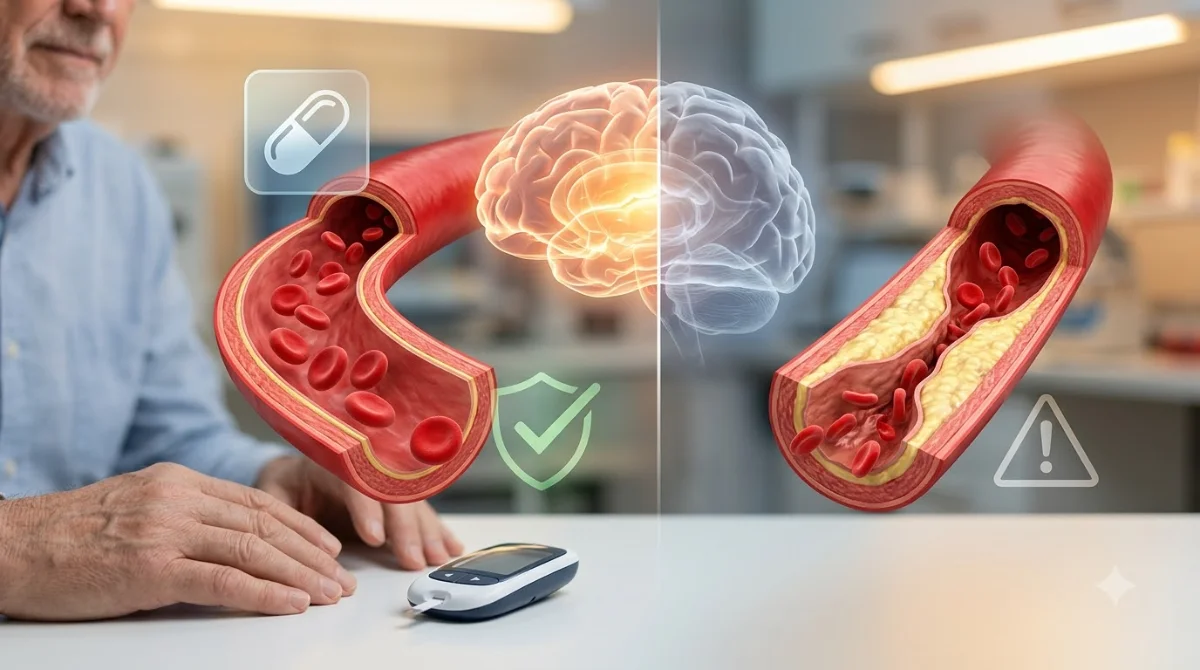
Low-density lipoprotein cholesterol, commonly abbreviated as LDL-C, is often referred to as “bad cholesterol.” High levels of LDL-C circulate through the bloodstream and gradually form fatty deposits along arterial walls, a condition called atherosclerosis. While statins are widely prescribed to reduce LDL-C and prevent myocardial infarctions and ischemic strokes, arterial hardening also impacts the fine network of blood vessels supplying blood to the human brain.
Brain cells depend on a continuous supply of oxygen and glucose delivered by blood vessels. Arteries narrowed by atherosclerotic plaque restrict oxygenated blood flow, causing micro-damage to cerebral tissue over time. This restriction can trigger vascular dementia or exacerbate underlying neurodegenerative conditions like Alzheimer’s disease. Statins operate by inhibiting an enzyme in the liver required to synthesize cholesterol, thereby clearing LDL-C particles from circulation. In simple terms, clearing excess cholesterol acts like unclogging a household water pipe, keeping fluid flowing smoothly to vital downstream organs.
Dr. Tummas Ternhamar of Copenhagen University Hospital presented the investigation in Munich. He noted that statins lower LDL-C and protect against systemic cardiovascular disease, which in turn may shield cerebral vessels from damage. “This may in turn protect against cerebrovascular atherosclerosis, ischemic stroke, reduced blood flow, and damage to brain tissue, offering a plausible link to explain our findings,” Ternhamar stated.
Global dementia burdens and the role of cardiovascular risk factors
Dementia represents an escalating global health challenge. Projections indicate that the number of individuals living with dementia worldwide will reach 153 million by 2050, up from current estimates. With primary therapeutic cures remaining elusive, medical research has turned heavily toward preventative strategies.
A report by the Lancet Commission on dementia prevention previously identified 14 modifiable risk factors spanning from childhood to late life. Modifying these 14 factors could delay or prevent up to 45% of global dementia cases. Detecting and managing elevated LDL-C starting in midlife was highlighted as a targetable risk factor. Type 2 diabetes itself is an established risk factor for cognitive decline, and adults with diabetes frequently present with elevated LDL-C levels.
Ternhamar observed that while statins remain underused among individuals with type 2 diabetes, treating elevated LDL-C early could serve a dual purpose by targeting both cardiac and cognitive health. He noted that the findings reinforce a multi-component preventative approach, emphasizing that early action yields better outcomes than delayed intervention.
How to interpret these observational findings
While the sample size of 132,585 participants offers statistical weight, independent experts stress that observational studies carry clear structural boundaries.
Prof. Bryan Williams, chief scientific and medical officer of the British Heart Foundation, emphasized that observational registry data can demonstrate statistical associations but cannot establish direct cause and effect. Williams noted that while observational designs cannot prove statins directly prevent dementia, previous clinical trial data make such a protective link biologically plausible.
Similarly, Prof. Isabel Goncalves, a member of the ESC Communication Committee who was not involved in the study, noted that because statins are off-patent, widely available, and inexpensive, establishing any protective benefit against cognitive decline carries practical clinical relevance. However, Goncalves emphasized that these observational results should serve as a foundation for further clinical research and inform dialogue between clinicians and patients rather than serve as definitive proof of causation.
Dr. Honorine Lebraud, senior partnerships manager at Alzheimer’s Research UK, added that the research adds to a growing body of work linking cardiovascular metrics to long-term brain health, summarizing the core takeaway: what benefits the heart appears to benefit the brain.
Related Coverage
- A 150-year-old heart drug that costs 10 cents a day kept patients out of hospital. The catch is in the fine print.
- After a type 2 diabetes diagnosis, men and women get sick in different ways, and the care system treats them as if they do not
Sources:
- The Guardian, “Statins can reduce dementia risk by up to 15%, long-term study suggests” (https://www.theguardian.com/society/2026/aug/30/statins-reduce-dementia-alzheimers-risk-study)
- Medical Xpress, “Early initiation of statins after diagnosis of type 2 diabetes associated with a lower risk of dementia” (https://medicalxpress.com/news/2026-08-early-statins-diagnosis-diabetes-dementia.html)
- NewsBytes, “Cholesterol-lowering statins may reduce dementia risk: Study” (https://www.newsbytesapp.com/news/science/statins-may-lower-dementia-risk-by-upto-15-study-finds/story)
Disclaimer: This article is for general information only and does not constitute medical advice, diagnosis, or treatment. Always consult a qualified healthcare provider about any medical condition or before making health decisions.